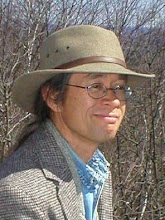
Thoughts . . . by Mark Rich

. . . scribbled . . . scrawled . . . trimmed . . . typewritten . . . grubbed up . . . squeezed from circumstance . . .

Showing posts with label self-effacement. Show all posts

Tuesday, May 15, 2018

Moon Tea and Whiteface (II)

Part One, June 2014, continued

When driving away from Madison, north and west through quieter territory than that the city offers, all this struck me — what I had said, and how I said it: "There we were, four white writers, reading to a white audience." In that audience I had anticipated more obvious racial diversity than what I saw; and that anticipation had been what made me think about introducing my example of non-diversity with a spoonful of self-denigration — an admission of my failure to possess the sort of creative imagination that has as its default setting a vision of diversity, not one set in place by dominant-culture pre-setting and imprinting. I say self-denigrating, for I have a tendency that may be self-defeating, as an "artist" in our culture. For our culture rewards self-proclamatory artists over others; and this tendency of mine is to admit to my self-perceived shortcomings. I resist the tendency at times, even while embracing it as a sign that I am not overly self-deceiving — with self-deception being the Scylla to match the Charybdis of flattery.

"There we were, four white writers." At the reading I believe my mind had no such thought. At convention's end, however, I said this aloud. Even though I had just talked about having a "default white" way of viewing myself, which is not the same as saying that I have a white way of viewing myself, I used those words — "there we were" — perhaps so that I would have an unalterable fact to mull over while heading northeast.

I passed through few population centers, on my preferred route from Madison — towns with simple names that may embody white history and language: Plain, Loganville, Hillsboro. As far as I know they are mainly white-complexioned these days, although Hillsboro and its surrounding area once had a significant Black American component. Within Hillsboro a historical marker stands to commemorate either their former presence or their current semi-absence, since that particular community, a century or more ago, left the area.

Whiteface? However white that area might appear today, its history, in the time since the Native American expulsion, contains more than simply white history. In the Afrofuturism panel the term "one-drop rule" arose several times, with the panelists assuming the audience knew its meaning. Does that rule apply to village or town? In an organism, a one-drop rule must pertain to its entire life. In a community, too?

In a way, in my inadvertent statement — "there we were" — I demonstrated what I already had said of myself, in my of-the-moment realization that whatever I may be, I have felt uncertain enough about its nature that the course of least resistance has made me, in self-image, white. Although some individuals in my life have seemed to see my Japanese-ness, they may have known my parents first. In meeting Japanese people I usually feel the need to announce my being half-Japanese — as if certain that this cannot be seen. At such moments I believe that, in some way, perhaps in a purely symbolic way, I am a white man who, when he speaks, becomes non-white.

To make a gross generalization about the Japanese, they, or we, are realistic. While being realistic can lead to a certain hard-headedness, it may point toward adaptability, as well.

To make a gross generalization about Sansei, who are third-generation Japanese immigrants in America, we (I leave out the "they," since I have never had a question about being Sansei) tend to assimilate rather than stand back in order to assert our racial or cultural heritage. I have no idea, truthfully, if this tendency actually prevails among Sansei. Yet that it does exist in the group forms one certainty, in my mind full of uncertainties. Bill Hosokawa wrote a book entitled Nisei that chronicles contributions in America by second-generation immigrants, who were not only inventive and industrious but also clearly conscious that they occupied a distinct place among "Americans," generally speaking, in being Japanese. The U.S. government made sure that this awareness remained bedrock in their minds, through its actions during World War II; and the awareness helped give the Nisei a group-sense. No such similar experience strengthened the Sansei group-sense. That we had Japanese backgrounds no one was making quite so distinctly, vocally, or socially an issue.

I know I am more curious about my Japanese cultural roots than some in my generation: for some do seem content to erase their Japaneseness in becoming part of that "Americans, generally speaking" group. Yet I may feel more open to my Japaneseness because my mother, in marrying my Anglo-Swiss father, half-erased my Japaneseness on my behalf. My own Sansei tendency to erase my Japaneseness, to "assimilate" myself, has less to work with, while my curiosity and inclination to draw out my Japaneseness has more, since my already-assimilated "white" self can be whole-heartedly curious, when it wants to be.

The question rises, as I write these thoughts, as to what I saw when I looked in a mirror, as a child. Did I even look? As a child I was, of course, short. The bathroom mirror hung in its usual place, at adult eye-level above the sink. My parents had, as I recall, a full-length mirror on the inside of their bedroom door, into which I rarely peered. Even when I did, who knows what I saw. I remember when I was young and my younger sister was a year or two old, that she had the lightest brown hair — the hair, I am supposing, of my father's mother, Ada, whose lightness of hair and complexion seems to have been part of her Woodbridge inheritance, the inheritance that gave my father an appearance markedly different from the men of the Rich family of my grandfather's generation. They were large men with prominent brows, strong jaws, and hair dark enough to pass for Japanese. At a few years old, my sister looked more Woodbridge — as it seems to me now. She later acquired an appearance with more Kikuchi elements, to my eyes.

As we grow older the images we take to the mirror change — as do our inner resources for seeing, not-seeing, or reinventing the reversed object, the backwards fact, that we find looking at us.

As it happens, the short story I read aloud, Saturday at Wiscon, included a passage in which the woman character — the one whose racial identity I feel uncertain about but who is, all the same, as I am — looks into a mirror, not at herself, at first, but at a cloudy image that seems to be there, behind her.

(Continued in next post.)

Monday, May 14, 2018

Moon Tea and Whiteface (IV)

Part Two: April 2018

I wrote all the above, in rough, soon after Wiscon 38. Before leaving the convention I had mentioned to Timmi Duchamp my perception that the event had been for me a journey. She replied that it sounded like something she might like for The Wiscon Chronicles. Afterwards, then, I began delving into my thoughts, only to abandon them — there, at that paragraph above this one, when I reached that crux question. At that point in the essay, knowing it had moved far beyond the word-limits for the Chronicles, I wondered what worth there might be for me to go on writing any farther. I felt I might have thousands of words yet to go.

Too, by June seventh — that last day when I was writing — I was feeling already the weakening grasp of the soul awakening from a thinning dream, with conscious perceptions hardening to the factual day. What had I seen and where had I gone? Was I, any more, the one to say?

In a week may seem too short a time to lose one's grip upon what an event had been, or upon who it was, who rode a cobbled-together raft on currents stirred by happenings. Yet such losses occur instantly. Just before or just after talking with Timmi about the journey — not the one undertaken but the one that had happened without being undertaken — I talked with Sherry Thomas about an insight that had arrived during the convention. The verbal music that I conjured at that moment, accidentally, led me to a further place that I had not realized I had reached. The thought rose in me that I should rush aside to write this down, that I might find my way back to that further place. Something in me knows when a new thought is fleeting. Whether I have access still to that further place will remain forever unknown to me, however: for I remained rooted to the social moment, not the personal one. I left behind that journey of many steps and many possible ends, with the brightest end having revealed itself obliquely only to take itself away.

Yet many things, in the second week in June, combined to take me away from seeking through memories and notes to redraw a map I had failed to draw when the moment was right. Summer developments in garden and daily life called; and that difficult shrugging-off of the ghost that overhung the long gestation and execution and aftermath of the C.M. Kornbluth effort remained for me to finish — unless it remained for me to I simply accept that particular haunting as mine.

It may be, too, that I held too much to that Wiscon for its factual aspects, and so remained too near it, for all that it already felt far away.

Whether or not distance needed to fall between me and what I had experienced, the distance fell.

##

In 2014 at Wiscon I did set out with a programme in mind: to find new writers to whom to listen. Not having read Hiromi Goto I planned to attend her events. Her guest-of-honor reading unfortunately fell against the panel on reconciliation, which, as I noted, called to me with a nearly imperative tone. Jemisin's calm and thoughtful approach to her subject, and to her audience, as it happened, altered my programme: for afterwards I found that the programming offered little of Goto, and ample of Jemisin, whose voice I did wish to hear more. Given that I was also spending time way from events — editing my story, reading passages aloud to myself, retyping pages on an old typewriter — the experience turned out oddly skewed, and perhaps spare.

I attended a panel featuring Goto on a "cultural grammar of experience," the panel description having led me think it would focus to some degree on her, her works, and the Japanese experience; and I listened with some regret to a discussion moving elsewhere than that. Goto, after a time in which other panelists spoke sometimes vehemently, said a few quiet words. An irony played into my later attending a panel called "Not All Aliens are Japanese" — a Jemisin panel, not a Goto one. I enjoyed it — Eleanor Arnason being in particularly fine form — although I felt unclear about why the panel had the title it did.

In looking back, however, I saw that in the program description appeared this: "#EndJapaneseElves." I supposed then that the panel's title had something to do with Anime, about which I know nothing. With that thought, in that week after Wiscon, when I was pondering the lack of Japanese-related content at a convention that in part was honoring a Japanese-Canadian writer, I noticed finally that the program guide did list Anime-related topics — which I suppose means Japanese-ness to many. It means anything but, to me.

I find now in my typewritten journal entry just after the convention these words: "I have been thinking while typing these thoughts of the tendency of Japanese to be self-effacing and how it reflects something exterior to the Japanese themselves: for this programming essentially holds up Japanese experience and effaces it."

How much does this matter? Little, perhaps. Goto herself may have felt comfortable in not being drawn into discussions about Japanese-related experience. The appearance of effacement merges back into self-effacement. And my taking interest in outwardly Japanese-related matters was the Sun tea I sought, not the Moon I found.

The panel on reconciliation had so diverted me from my programme, in any case, that the Afrofuturism panel then called me to attend it — in unconscious whiteface. There I heard that reference to the "one-drop rule," which, it seemed apparent, related to one's participating in or claiming a heritage.

For me, at least, the "rule" would seem to offer a red-light, green-light game. At one moment I might be a "white" man, having that drop of white blood; the next, a "colored" man, having that other drop. Given blood transfusions and retrovirus gene-splicings one might think it inevitable that all people would end up both the default and the option, at once, or in alternation. Anyone might take a bow on a stage and be unsure whether one did so in whiteface or blackface; we might set out to wear the one and end up in the other; or you might wear the one while the audience saw the other. And I could always call myself one thing, whenever I looked the other.

And as with Sun tea and Moon, we might feel hard-pressed to the tell the difference.

Yet with Moon tea, although I never know what it will be, I do know what it is — whereas with whiteface or Japaneseface it seems I never can know. By nature I can only assume them, or wear them, but never be what they represent.

In never-so-being lies the not-knowing.

##

How does reconciliation fit the one-drop perspective? The latter seems too much a trick and a game, except when it provides a grounding fact to help explain one's own feelings about one's identity. If it does have any grounding effect, then it seems unfortunate that it so easily leads to thoughts so facile and flip as those I wrote a few paragraphs ago. Does not the thought that one might alternate between states of self-identity seem contrary to the nature of identity? If we undertake a journey do we not seek to find who we are, even if the journey's outward purpose may be to see and experience that which lies outside us — and to seek that which was beyond the reach of who we were? For is not our own identity at the heart of this matter? Can we reconcile ourselves to others, or others reconcile themselves to us, if neither we nor they know who we are — if our identity may be switched on and off at will?

Yet identity provides the base not only for action, for involvement in the world, but also for identification — for putting ourselves in another's shoes, another's geta or zori; and also for imagining our taking the journey that others have taken, through gates we cannot pass. Identification may be a reflex born of identity — a reflex that takes us outside ourselves — outside our self-identity — only then to swing us back to self-identity, enriched with the iota of changed perspective that alters the thought-continuum within which we exist.

From that perspective, the one-drop concept proves provocative. For can I partake of your journey — can I understand it — without the one drop of you within me? Can you follow me to this point without one drop of me, in you? I will never be that one drop of you. You will never be that one drop of me. Even so the thought-currents, the continua, begin to touch or merge or overlap; they alter, transform, and redirect themselves; and when they do, any such changes as do occur neither of us could have planned.

In other words it lies within our powers to do what is firmly outside our beings — to alter the world, simply through our having identity. If we need to put any face on this power then let it be the face of identity; if we must use the word default let us relegate it to some spiritless electronic program; if we are to think in terms of the genetic drop of enrichment or contamination then let us think of those streams, those currents, born in and borne upon, within and around, the souls that we believe to be ours — those streams and currents for which a single drop sometimes serves, in representing us — and sometimes serves, too, in the encounter, to divert an entire stream.

And as I write these words I do better realize the nature of that woman-character in that story of mine: for she is one apt to find herself drinking Moon tea.

Having turned to that now-years-ago Wiscon and its long-abandoned trail of memory and dream, maybe I should turn again to the story. "The Gate to Elfland," I called it, then. I have had another title in mind for it, for a year or so. "The birds have less to say for themselves, in the wood-world's torn despair," Robert Frost said a hundred years before the Wiscon of which I speak, "than now these numberless years the elves, although they are no less there." These lines nestle among the poems I keep in mind, these days. The unseen elf, the industrial evocations, the automobiles: these are whitenesses in that tale that I read aloud ... in whiteface. And into those places, those whitenesses, in my writing, I had thought sunlight fell. Should I see where moonlight fell, instead? Or where, unknowingly, I might have prevented its falling? I may need to look.

The End