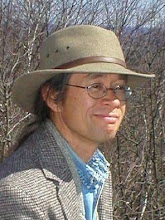
Although Cyril Kornbluth lived only to age 34, the amount of material I had to review, absorb and fit into the life-and-career story that became C.M. Kornbluth: The Life and Works of a Science Fiction Visionary was fairly sizable. The book itself became sizable, too -- some 240,000 words, as I recall. I ended up doing much of the writing directly to electronic file. I regret this, since a few repetitions and other problems resulted that I might have avoided, had I fleshed it out on paper, first, at a more leisurely pace.
Although I type with some rapidity, I find that the slower nature of the manual typewriter, as against the faster electronic keyboard, results in cleaner, more interesting writing. The eye and mind are not hypnotized by the radiant screen. The light of day, usually, illuminates the page.
Handwriting sometimes goes more slowly but sometimes as quickly as typewriting; yet in the long run it may lead to the shortest writing times. Handwriting seems to lead the mind to produce its most thought-out, most interesting, most well-wrought sentences -- so that the time spent in rewriting is all the less.
For deadline writing, word-processing -- a term of significant homeliness, quite in keeping with our Age of the Masses -- has its advantages.
Yet as with other automations, it offers increased production of diminished-quality results.
I suspect our age, so prone to look down upon the productions of earlier ages, has produced record quantities of writing not worth reading.
Cheers ...
Showing posts with label pencils. Show all posts
Showing posts with label pencils. Show all posts
Tuesday, February 23, 2010

Monday, February 15, 2010
Fresh from Cradle, and Cribbing
The news last week about "novelist" Helene Hegemann, of Berlin, Germany, seems less like news than a re-run confirmation that our Age of Masses is insane in a way quite different from the way the Modern was. Hegemann has used cut-and-paste methods in "writing" her novel -- a natural outcome, perhaps, of living in a global culture in which cut-and-paste refers to an activity no longer restricted to kindergarten.
Hegemann's being up for an award worth $20,000 from the Leipzig Book Fair, however, gives belated recognition to the artistic success of the Activity Book of our childhoods, which usually was printed on newsprint and was meant to be "read" with blunt-tipped scissors and colored wax crayons at hand. We can only hope the Leipzig Book Fair judges have these essential tools within reach; and we can hope the local kindergarten can spare a teacher to supervise judging.
Hegemann's "novel," of course, is only a pimple on the face of a society that has been eating factory food. It comes in for mention here as an example of what this effort of mine, this discussion, stands against.
With all due respect I would suggest Hegemann try to write a short story using a pencil. Writing is the finding of a line to follow -- usually a line that is invisible until the setting of pencil to paper. While a pencil may be used in cribbing, it is such a fine tool for finding lines that reveal inner worlds as well as outer ones that its use might shame even a plagiarist into removing the horrifying mask of Age-of-Masses stupidity.
Subscribe to:
Posts (Atom)